NESB project: Advancing Transboundary Governance Session at the 5th Baltic MSP Forum
The Northern European Sea basins project organised a parallel session at the 5th Baltic MSP Forum (11-12 November 2025 in Riga, Latvia) “Advancing Transboundary Governance: Baltic and North Sea Challenges and Prospects”. Session brought together experts, practitioners, and MSP stakeholders to examine how cooperation across sea basins can become more adaptive, inclusive, and coherent.
VIDEO recording of the session is here.
Moderated by Magdalena Matczak (Gdynia Maritime University – GMU), the session aimed to identify practical pathways for strengthening transboundary governance and to highlight how cross-basin learning can future-proof MSP-related structures in Europe. The session opened with a Slido question prompting participants to reflect on what leads to failure in cooperation—surfacing early concerns such as weak implementation, insufficient capacity, and the absence of trust or dialogue.
Prof. Christian Zuidema (Groningen University) set the scene with a compelling presentation on the future of the North Sea, emphasizing the enormous spatial demands ahead: offshore wind targets increasing from 33 GW to over 300 GW, significant ecological pressures, and mounting expectations for nature restoration. He highlighted three core constraints of such a change: ecological space, physical space, and institutional capacity. Ecological space is limited by contested interpretations of the ecosystem-based approach and gaps in ecological knowledge. Physical space is restricted by dynamic policy choices and competing claims, requiring scenario-based planning and integrated infrastructure approaches. Zuidema underscored that international MSP is not merely beneficial but essential to cope with such challenges. Coordinated planning can reduce costs, minimize environmental impacts, and unlock tens of gigawatts of additional capacity—yet national differences, fragmented processes, and reluctance to formalize cooperation remain major barriers.
Prof. Jacek Zaucha (GMU) and Juul Kusters (Groningen University) presented an overview of existing cooperation structures in the Baltic and Greater North Sea regions, drawing on insights from the NESB project. While both regions host a rich network of collaboration formats—from the formal HELCOM-VASAB MSP Working Group to more informal North Sea MSP groups—cohesion often breaks down at jurisdictional boundaries. There is a clear need for more flexible, agile structures that can adapt to emerging technologies, regulatory gaps, and new cross-border projects.
Reflections by Nick Boxem (Government of the Netherlands, Manager, Marine Policy Directorate Netherlands, GNSBI Steering group member) and Kai Trümpler (Director of Spatial Planning, Federal Maritime and Hydrographic Agency of Germany, Co-chair of HELCOM-VASAB MSP WG) highlighted urgent needs such as enhancing visibility of cooperation processes, fostering trust, clarifying mandates, and balancing formal and informal elements of collaboration.
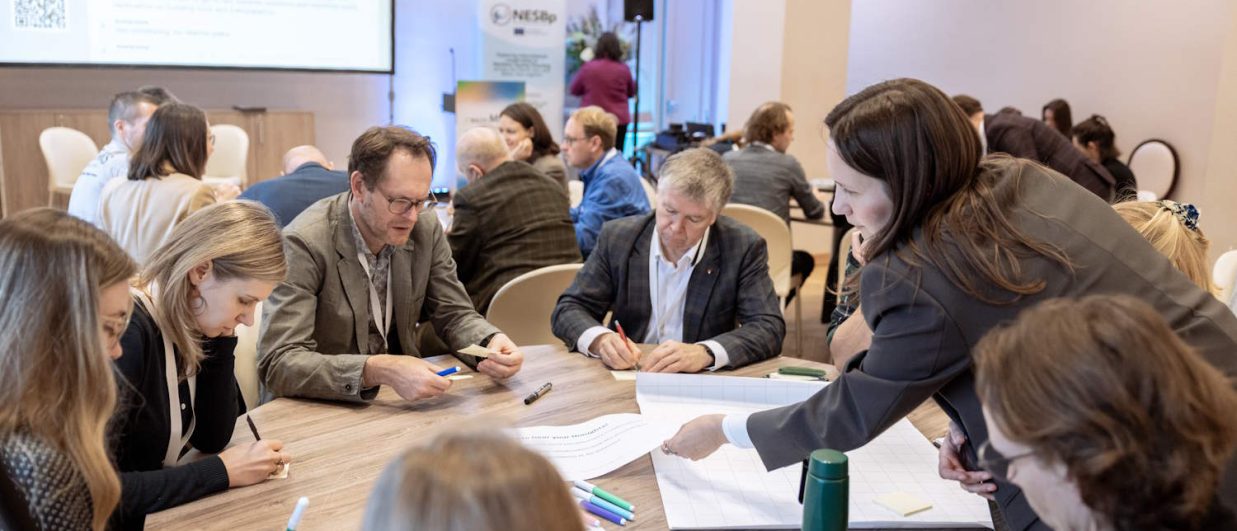
Breakout discussions confirmed these priorities: participants emphasized shared challenges, the necessity of learning from one another, the importance of dialogue, and the need for a more inclusive and binding form of transboundary governance built on mutual trust and understanding. The group work used a structured 1–2–4 method. Participants first reflected individually, then in pairs, and finally in table groups to identify urgencies, assess the fitness of current cooperation structures, and imagine ideal collaboration formats.
The results revealed several recurring themes:
- Shared challenges require shared solutions, especially in energy transition, ecosystem management, and resource use.
- Dialogue and mutual learning are essential, as “there is no knowledge without exchange.”
- Ideal collaboration is inclusive, binding, trust-based, and able to influence policy.
- Participants stressed the need for exchange spaces, clearer aims, better alignment of regulations, joint resource management, and more flexible combinations of formal and informal cooperation styles.
Work on these themes will continue within the Northern European Sea Basins project (NESBproject), ensuring ongoing collaboration, exchange, and development of improved transboundary governance mechanisms.
Session was organised by the NESB project partners. NESB project is co-funded by the European Union. Views and opinions expressed are however those of the project consortium only and do not necessarily reflect those of the European Union or CINEA. Neither the European Union nor the granting authority can be held responsible for them.