NESB Project in Action: From Mariparks to Basin-Scale Multi-Use
Northern European Sea Basins project (NESBp) achievements June – December 2025.
NESBp Work Package 4 “Multi-Use in Practice: From Mariparks to Basin-Scale Multi-Use” has been working on sharpening the vision for Mariparks that move beyond simple co-location of activities toward truly systemic sustainability. Through dedicated work benches, targeted research, and stakeholder engagement, the project is developing a shared vision and practical roadmap for Mariparks as integrated, net-positive marine systems.
From multi-use to systemic Mariparks
Since July 2025, four workbenches and several research activities have sharpened the vision for Mariparks, clarifying both the roadmap and the combinations of activities that can meaningfully coexist at sea. The vision we are developing is one that Europe should continue pushing multi-use and start moving beyond simple co-location of functions: multi-use is not only a tool of spatial efficiency, but should evolve into a driver of systemic sustainability. While an innovative sustainable blue economy remains the driving force, every Maripark should ultimately achieve a measurable net-positive impact on marine life, serving as our North Star.
Additional benefits follow naturally: Mariparks strengthen the energy transition and boost energy robustness, they contribute to European food security, improve spatial and logistical efficiency, streamline data and monitoring systems, and provide a framework for more coherent governance of maritime activities.
Achieving this systemic shift requires harmonised standards, regulatory flexibility, and planning at sea-basin scale to secure ecological connectivity, operational resilience, and cross-border coherence. The ambition is clear: multi-use is necessary, and only meaningful when delivered through systemic, scalable, and net-positive Mariparks.
Regulatory approach
To enable the installation of a Maripark, adaptations at sea-basin level must be defined to facilitate the combination of multiple uses. Allowing controlled regulatory experimentation through for example sandboxes can accelerate innovation while safeguarding ecosystems.
EU-level standards and shared frameworks are essential to harmonise permitting, monitoring, and ecological baselines, improving predictability and scalability for all Member States.
Planning must shift toward basin-wide coordination rather than project-by-project decisions, embedding Mariparks within MSP processes and aligning strategies across the North Sea, Baltic, Atlantic, and Mediterranean.
Investment in shared infrastructure and interoperability will ensure that energy, logistics, monitoring, and data systems are prepared for multi-use functions.
Governance models must also be strengthened by promoting flexible legal entities, port-based or basin-level structures provide good inspiration and are capable of managing long-term complexity, data flows, and stewardship obligations.
Achieving net-positive ecological outcomes requires shared indicators and verification frameworks to ensure that Mariparks actively regenerate ecosystems while supporting economic activity.
To operationalise this approach, NESBp Work Package 4 task 4.1, led by Mantis and IMDC, will organise a first workshop on governance, permits, and tenders for Mariparks in March 2026 (Brussels, Belgium), back-to-back with the European Ocean Days. In addition, task 4.2, which focuses on developing a Maripark Blueprint, will be integrated into the Community of Practice (CoP) in The Hague organised by CoP Noordzee (RVO), allowing further elaboration of regulatory and sea-basin requirements together with several SMEs. Stay tuned!
Scenario assessment and roadmap to installation
Our research shows that Mariparks will develop in successive stages, beginning with pilot projects in existing offshore wind farms, where small-scale aquaculture and floating solar installations are tested alongside nature-inclusive design and shared monitoring to assess feasibility and operational safety.
As technologies mature and reach TRL 9, the Maripark enters a development phase in which multi-use becomes structurally integrated: offshore wind farms start hosting larger FPV arrays and aquaculture units supported by coordinated logistics, multifunctional O&M vessels, and a dedicated management entity.
In the final stage, the Maripark becomes a fully integrated multi-use zone, where wind, solar, aquaculture, nature restoration, drones, and shared infrastructure operate as a coherent system; nearshore farms are relocated offshore at the end of their life cycle; repowered wind farms reuse part of their infrastructure; and dedicated nature areas remain protected. The result is a mature ecosystem that delivers renewable energy, sustainable food production, and measurable ecological benefits.
Multi-use session at the 5th Baltic MSP forum
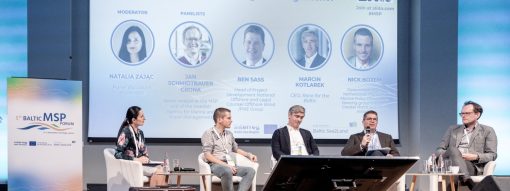
Work Package contributed to the 5th Baltic MSP Forum held in Riga (11-12 November 2025) through a dedicated sea-basin level workshop on Multi-Use “Effective Use of Space for a Sustainable Blue Economy: Baltic Approaches to Multi-Use in Marine and Coastal Areas”. Find out about the session here.
Watch the session recording here.
Deliverables to come (in revision process):
- Report on data generation and sharing on Mariparks. Smart monitoring (Deliverable 4.3)
- Scenario-building for Mariparks (Deliverable 4.4)
More about the NESB project’s Work Package 4 “Multi-use in Practice: From Mariparks to Basin-Scale Multi-Use” here.
Read more about the NESB project: www.NESBproject.eu
Co-funded by the European Union. Views and opinions expressed are however those of the project consortium only and do not necessarily reflect those of the European Union or CINEA. Neither the European Union nor the granting authority can be held responsible for them.