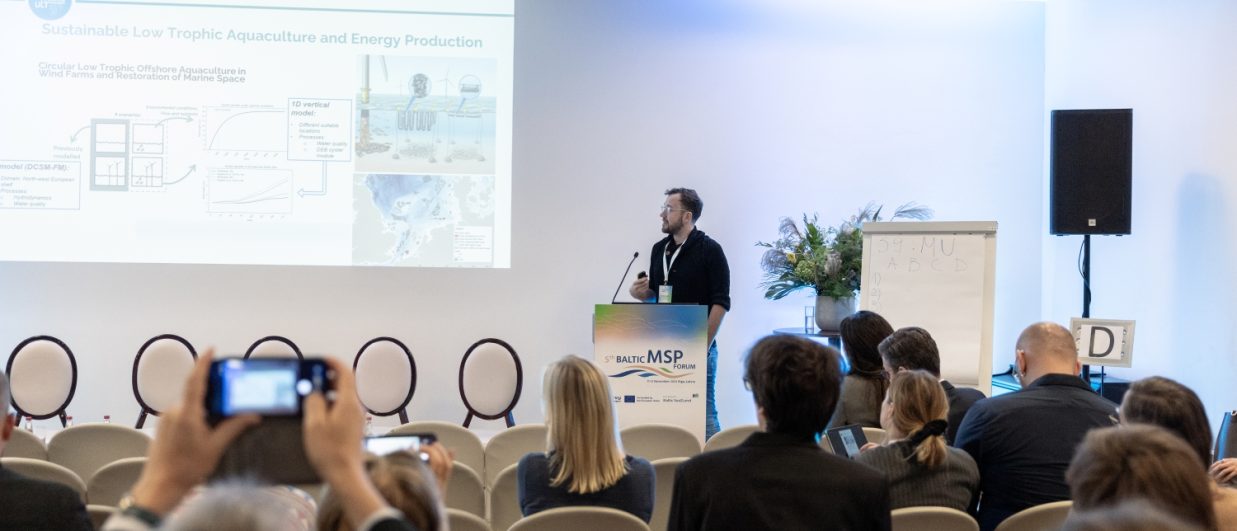
NESB project: Overview of the multi-use session at the 5th Baltic MSP Forum
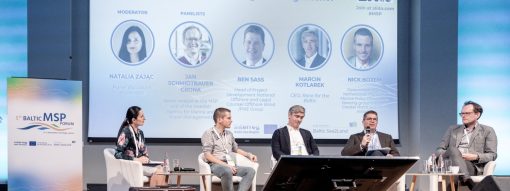
The Northern European Sea Basins project organised a parallel session on multi-use topic at the 5th Baltic MSP Forum on 11-12 November 2025. The session “Effective Use of Space for a Sustainable Blue Economy: Baltic Approaches to Multi-Use in Marine and Coastal Areas” brought together practitioners, authorities and researchers to examine current progress and emerging opportunities for multi-use solutions in the Baltic and North Sea.
VIDEO recording of the session is here.
Organised by the SUBMARINER Network and VASAB Secretariat, the session gathered 40 participants and introduced recent studies and pilot activities across the region. Presentations addressed technical, regulatory and governance insights from multi-use analyses in the German EEZ, Nordic experiences with coexistence between offshore wind and fisheries, and the Maripark concept as an innovation-oriented framework for accelerating multi-use deployment. The ULTFARMS project contributed practical lessons from ongoing low-trophic aquaculture and restoration pilots in offshore wind farms.
Presentations and speakers:
- Study on current and future possibilities for multi-use in the EEZ — Germany/BSH — Bettina Käppeler
- Study on coexistence between offshore wind and fisheries (Nordic region) — Nordregio — Kerstin Bly Joyce
- Maripark as a concept / one of NESBp’s Maripark pilot cases (North Sea / international) — Blue Cluster — Kinnie De Beule
- Multi-use pilot cases from ULTFARMS — Deltares — Alexander Ziemba
Review the presentation here.
A live Slido exercise was used to explore stakeholder expectations regarding feasibility, barriers and policy pathways. Participants broadly agreed that significant multi-use implementation is likely within an 8 to 12 year horizon, signalling that the sector is progressing but not yet ready for rapid large-scale deployment. The discussion revealed that the most significant constraints lie not in technical feasibility but in economic and regulatory enabling conditions in both the Baltic and North Sea regions. Unclear business models, limited bankability and insurance challenges were identified as the primary bottlenecks, closely followed by permitting fragmentation. These issues highlight the need for predictable long-term planning frameworks so that both offshore wind developers and secondary users can invest with confidence. Participants also emphasised that, much like offshore wind in its early stages, secondary uses will require targeted financial support to become commercially viable.
Results of the LIVE-SLIDO session:
Upscaling horizon: By when is significantmulti-use feasible in the Baltic Sea basin? What about the North Sea basin (any insights)?
A. Within 3 years – 1
B. 3–7 years – 11
C. 8–12 years – 18
D. Beyond 12 years – 2
Primary bottleneck to scale: Which barrier ismost limiting to upscaling? Baltic Sea? NorthSea?
A. Permitting and regulatory fragmentation – 14
B. Technical standards and safety rules for shared assets – 0
C. Bankability/insurance and unclear business models – 16
D. Stakeholder acceptance and perceived risk – 0
Policy instrument that would help most with MU advancements: Which policy lever would most accelerate MU in the Baltic Sea? What about the North Sea?
A. One-stop permitting for co-located uses – 3
B. Financial incentives tied to co-location – 19
C. Sea-basin MSP guidance with MU or innovation zones – 0
D. Mandatory MU assessment for large offshore projects – 9
Preferred multi-use combinations: Which combination should be prioritised first in the Baltic Sea basin? ….or which combination will be most relevant/is most relevant? What about the North Sea?
A. Offshore wind + seaweed/mussels – 5
B. Offshore wind + restoration (e.g., oyster/reef, nature-inclusive design) – 20
C. Offshore wind + renewable energy (wave and solar energy) – 0
D. other – 6
When reflecting on strategic priorities, participants identified offshore wind combined with restoration and nature-inclusive design as the most relevant and impactful multi-use pathway for both the Baltic and North Sea basins. This preference reflects growing alignment between MSP, biodiversity objectives and the requirements of the EU Nature Restoration Law. Overall, the session underscored that while technical feasibility is advancing, progress now depends on enabling governance: coherent regulation, large-scale demonstration sites, cross-sector integration and targeted financial instruments and support to accelerate the transition from pilots to commercial-scale multi-use in the Baltic and North Sea basins.
Session was organised by the NESB project partners. NESB project is co-funded by the European Union. Views and opinions expressed are however those of the project consortium only and do not necessarily reflect those of the European Union or CINEA. Neither the European Union nor the granting authority can be held responsible for them.